Yummy!
Tuesday, July 15, 2014
Idle Summer Thoughts
Like most of the rest of Michigan, we have slipped into the fullness of summer here in Van Buren County. The corn is as high as, well, maybe not the elephant's eye, but certainly his elbow. Young rabbits are everywhere, making me think of renaming the months according to their most noteworthy features. Julius Caesar has been gone for a long time, but hundreds of bunnies are risking their young lives on the roads now. I would rename July Leveret. Yes, I know the word leveret refers to a European hare in its first year, but leveret is such a great word, isn't it? It deserves to come out and play more often. Or I could call it Nuthatch Moon, for the broods of noisy nuthatch fledglings chasing their parents through the trees in our yard as I am writing this. Or Blueberry Moon. Goodness knows, blueberries are a striking feature of July. Or maybe I won't name the month at all. Maybe I will just let it be what it will, let it define itself by its own events, playing its part as the wheel of the seasons turns.
Saturday, July 5, 2014
Farmer's Market Livens Up Lawrence
![]() |
| Welcome to the Lawrence Farmer's Market |
The village of Lawrence, (exit 52 off I94), is usually pretty sleepy - the sort of town that you can drive through on Red Arrow Highway without even realizing it. But on Saturday mornings from 9 am to 1 pm, it wakes up and becomes a lively place. The cause is the Lawrence Farmer's Market, and today was the first market of the season. When I visited around noon, there was still quite a bit of foot traffic, and lots of visiting going on. Several of the local organizations had fund raising booths and there were a variety of crafts, baked goods, and honey and soap products available. Produce is still on the light side, but there were a few berries, flowers and herbs available. A local woodworker operating under the name Wood Be Beautiful had a nice selection of his wares on display.
![]() | |
| Intriguing handmade wooden boxes |
![]() |
| This hickory bench was priced at $70 |
![]() |
| This local landmark, the Circus House, is across the street from the farmer's market |
I never know what I will find at the Lawrence Farmer's Market, but, as the produce starts to come in, I know it will be on my weekly list of shopping stops. There may be live music, free range meats, or a selection of artisan cheeses. Whatever is available, I recommend checking it out if you are in the area.
All photos by Dixie Burkhart
I am not affiliated in any way with the Lawrence Farmer's Market or any of its vendors.
Wednesday, May 7, 2014
Migration Heats Up Van Buren County
Today's walk at Wolf Lake State Fish Hatchery coincided with what was, for me, the first true day of spring. There was so much bird song that it was hard to sort through it. We found Gray Catbirds building a nest behind the equipment barn. The Trumpeter Swans were working on their nest, as well. The male pulled vegetation off the bottom, piled it at the edge of the nest, and the female arranged it to her liking. We had three species of vireos, five species of warblers, and eight species of shorebirds.
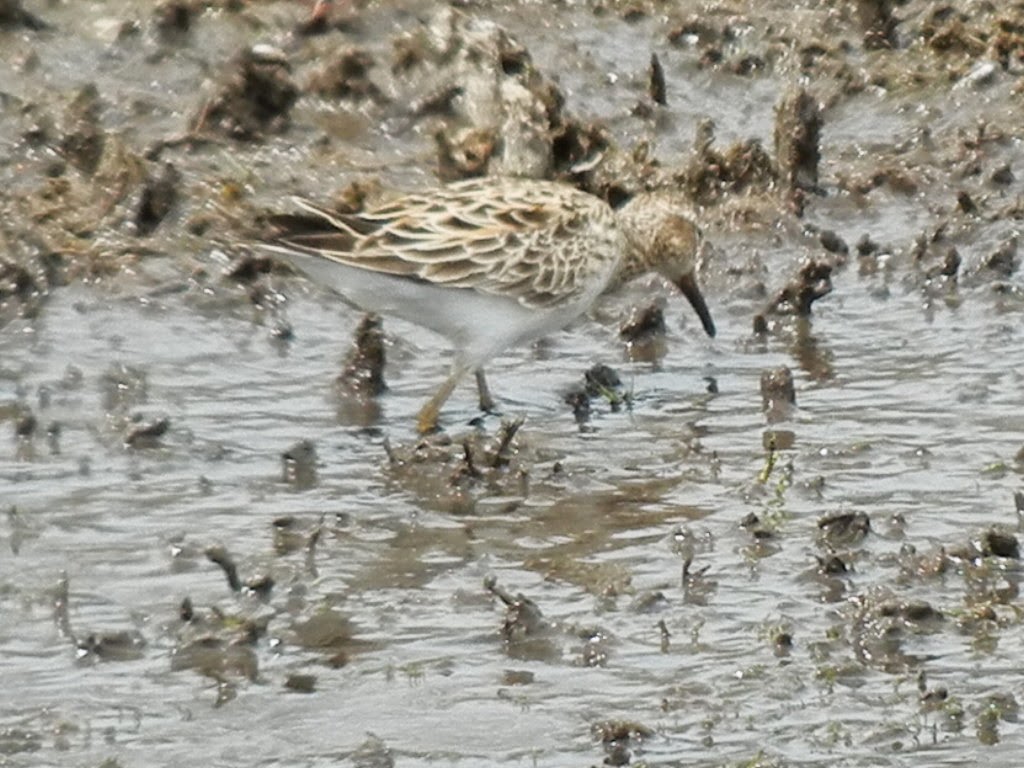
Speaking of shorebirds, we saw this guy, who stood out in the crowd of Least, Solitary and Spotted Sandpipers.
I have seen tons of Pectoral Sandpipers. I thought I knew what they looked like, but this guy did not look like any Pectoral I have ever seen. I was forced to realize that, although I have seen a bunch, I guess I have never had one at my feet where I could actually see the details. My toolbox for sandpiper ID is not comprehensive. 99 percent of the sandpipers I have seen have been at the outer limits of my optics, where I am dependent on size and shape relative to the other birds present, and one or two obvious plumage issues, like the clearly defined breast markings on the breast of the Pectoral. So I guess the question of the day is, is it possible to see a bird too well? : ) And the lesson of the day is that you are never done getting to know a species of bird, even ones that you see all the time. There is always different lighting, different substrate, different distances, that can change what you thought you knew.
We wound up with 48 species for the day, at the hatchery, at least. I added a few more at home, as did some of the other people who joined me for the walk. It is some kind of an indicator of how dramatically things have changed today that I added nine species to my year list, even though I have been out birding almost every day for weeks, at least for a few minutes a day.
For those who would like more details, here is a link to our checklist on ebird.
Email me at dixieburk@aol.com for more information about birding Wolf Lake State Fish Hatchery. Until next time, Bird on!
Speaking of shorebirds, we saw this guy, who stood out in the crowd of Least, Solitary and Spotted Sandpipers.
Photos by Dixie Burkhart
I have seen tons of Pectoral Sandpipers. I thought I knew what they looked like, but this guy did not look like any Pectoral I have ever seen. I was forced to realize that, although I have seen a bunch, I guess I have never had one at my feet where I could actually see the details. My toolbox for sandpiper ID is not comprehensive. 99 percent of the sandpipers I have seen have been at the outer limits of my optics, where I am dependent on size and shape relative to the other birds present, and one or two obvious plumage issues, like the clearly defined breast markings on the breast of the Pectoral. So I guess the question of the day is, is it possible to see a bird too well? : ) And the lesson of the day is that you are never done getting to know a species of bird, even ones that you see all the time. There is always different lighting, different substrate, different distances, that can change what you thought you knew.
We wound up with 48 species for the day, at the hatchery, at least. I added a few more at home, as did some of the other people who joined me for the walk. It is some kind of an indicator of how dramatically things have changed today that I added nine species to my year list, even though I have been out birding almost every day for weeks, at least for a few minutes a day.
For those who would like more details, here is a link to our checklist on ebird.
Email me at dixieburk@aol.com for more information about birding Wolf Lake State Fish Hatchery. Until next time, Bird on!
Thursday, May 1, 2014
Trip Report: Closing out April at Wolf Lake State Fish Hatchery
It was damp, it was windy, it was overcast. The sensible people (everyone except me) stayed home. I almost got back in the car and headed back home for some hot chocolate. Then I decided, since I hadn't been there for about ten days, I would at least check and see how the Trumpeter Swans were coming along. As I geared up, I found a Pine Warbler singing in the trees over the parking lot.
This fellow was hunting the show pond.
I headed back around the hatchery buildings where I found this little guy sitting on the fence. The fuss with the scope and camera didn't bother him and I was able to get a few nice shots.
Yes, there is such a beast, but it has never been seen in the US, as far as I know, and I really don't want to try to separate the two. I have enough trouble telling them from Bank Swallows!
This fellow was hunting the show pond.
| Great Blue Heron |
I headed back around the hatchery buildings where I found this little guy sitting on the fence. The fuss with the scope and camera didn't bother him and I was able to get a few nice shots.
| Northern Rough-winged Swallow, as opposed to the Southern Rough-winged Swallow |
Yellow Warblers were everywhere - my first of the year for Van Buren County. The female Trumpeter Swan was busy building her nest while the male kept watch near by. Most of the ducks are gone, but there was a single American Coot left of the hundreds that were there two weeks ago, a few Ring-necked Ducks, Ruddies, Mallards, and a really gorgeous pair of Wood Ducks.
From the big pond I went through the woods, where I picked up my FOY Warbling Vireos for Michigan. Towhees were also everywhere, as well as Yellow-rumped Warblers.
The first pond I came to was still dry, but there wasn't even a Killdeer to be seen. I hit the jackpot when I got to the ponds beyond, however. The first clue was the Spotted Sandpiper that flew by on stiff wings. It landed along the edge in the pond where the gallinules nested last year. Then I saw a second bird which I thought was a peep at first. It turned out to be an American Pipit, though. Before I could look as much as I wanted a Red-winged Blackbird chased it off.
Maybe it is just me, but I can casually look at a mudflat full of shorebirds and not see a thing. It is only after I look carefully through scope or binocs or both that the birds slowly start to take shape to me. That was what happened today. First I saw this guy stuffing himself with some fat tadpoles.
| Greater Yellowlegs |
Then I spotted my FOY Solitary Sandpiper.
| Solitary Sandpiper |
There were also a few Least Sandpipers, early enough that when I put them in ebird, the check box came up asking for more details.
| Least Sandpiper - note the brownish color and the yellow legs. |
Just to confuse matters, there was also this Least, definitely not as far along in his spring molt as the first one.
The real excitement of the day started, though, when I got the scope on this bird.
| ?! Note the bright orange legs. |
There are two species of a shorebird called a Redshank - Common and Spotted. They look a LOT like this guy. And you probably have a better shot at winning the lottery than seeing one in the lower 48. After some sweating and stalking and a few dozen pictures, and a shout-out to Kip Miller (thank you, Kip!), I was able to confirm that it was just a really orange-legged Lesser Yellowlegs, before I wound up in the ER with a heart attack! If you Google Common Redshank and look through the photos, you can see why I was getting worked up about this bird. I now feel I am well prepared for the next Redshank that crosses my path. As a public service, I will get down to details in my next post. : )
In all, I had great looks at around thirty shorebirds of five different species. The total for the day was 48 species for the hatchery only.
Don't forget that the weather is improving, the birds are moving, and we will be walking the hatchery again next Wednesday, May 7, starting at 9am. Drop me a line if you need further details. Hope to see you there. Until then, Bird On!
All photos in this post by Dixie Burkhart. Feel free to borrow, but give credit, please. It is just nice! : )
Wednesday, April 30, 2014
Winter in the Rear View Mirror at Last!
After a winter that seemed like it would never end, a few brave wildflowers finally raised their heads last week. I think I have the ID's correct - any corrections more than welcome!
All photos by Dixie Burkhart.
| Rue Anemone |
| Spring Beauty peeks out of last fall's leaves. |
| Dutchman's Breeches is one of my favorites. Too bad they bloom so briefly. |
| Toad Lily dresses up the junk pile. |
| May Apple always tickle us with its sudden appearance - like an alien army that appears overnight. |
Thrill of the Chase
Recently birders in southwest Michigan were in a frenzy over the presence of, not just one, but two birds that are megarare for the state. A Black-bellied Whistling-Duck found a haven for a time at the dairy at Andrews University. And, after some initial confusion, a Snowy Plover was identified at the harbor in New Buffalo. In general, I am not much of a chaser when these rarities show up. But these birds were withing fifty miles or so of where I live, and even if I didn't find them, Berrien in the spring is always a worthwhile birding destination. Results of my chase are in the photos below, even though the duck photo deserves some kind of award for Worst Identifiable Picture. Plus, I share with you the gorgeous Glaucous Gull that shared the beach with the Snowy Plover and his Sanderling buddy that day.
This little western plover stayed close to his Sanderling buddy throughout his stay. Actually, the Sanderling was unusually early, and elicited a details request on ebird. For some reason, most viewers only used him as a landmark for the Snowy Plover. "Look for the Sanderling." "He's still there with the Sanderling." "He's to the right of the Sanderling." Sort of like the rare bird stepchild. : )
All photos by Dixie Burkhart. Use with permission only. (Except for the duck - use that one anywhere, as long as I don't get credit!)
| This first winter Glaucous Gull was hanging with the gull flock at New Buffalo. |
Black-bellied Whistling-Duck
Hmm. Somehow I managed to take a picture that showed only the field marks for this duck. I wish I could attribute it to quirky awesome photographic skills. I can't.
| Sanderling, left, Snowy Plover, right. |
All photos by Dixie Burkhart. Use with permission only. (Except for the duck - use that one anywhere, as long as I don't get credit!)
Wednesday, October 23, 2013
Trumpeter Cygnet - Journey's End at Wolf Lake Fish Hatchery
As forecast, October has been a crazy month for us, so far, and I haven't been anywhere near Wolf Lake Fish Hatchery since we ended our fall walks there on October 3. However, some folks who do get out there every once in a while drop me an occasional email that keeps me in the loop about what is going on out there. The last couple of days, however, the news coming from the hatchery, via Carol Beurkens-Borden, was sad. She walks there almost daily with her dogs, and she wrote yesterday to tell me that the Trumpeter cygnet was sitting on the trail near one of the ponds, and didn't look well at all. She notified the visitor center staff, and, apparently, they were attempting to get help for the sick swan. By the time a wild bird shows signs of illness, however, its condition is usually extremely critical. This certainly applied to the young swan, as Carol found today when she walked that it had died.
We don't often get the chance to see more than the most fleeting moments of a wild animal's life. Getting to see the same individual repeatedly, to watch it almost from hatching, observe how the parents cared for it, and how its behavior changed as it grew almost to full size, is a special, rare opportunity. And to know, not only how the journey began, but how it ended, is even rarer. Most wild things live their lives unknown and unobserved. The Trumpeter cygnet's life was followed eagerly by folks from all over southwest Michigan, and it and its parents probably deserve some kind of recognition as the most photographed individual Trumpeter Swans in Michigan, if not the Midwest. It is easy to slip into our human value system, and say that it wasn't fair that the baby bird we watched grow up didn't survive into independent adulthood. It is easy to say that the parents deserved a better outcome for all their hard work and devotion. But nature has no concept of fairness or fairy tale endings. The vast majority of young things do not survive to their first birthday. It is so sad that the little gray cygnet we all enjoyed so much was a member of that majority. But I feel so fortunate and privileged that I was able to witness the family's story unfold. And I wish the cygnet peace, and better luck the next time around.
Subscribe to:
Posts (Atom)